John Rebus—Tony McCall friendship and betrayal
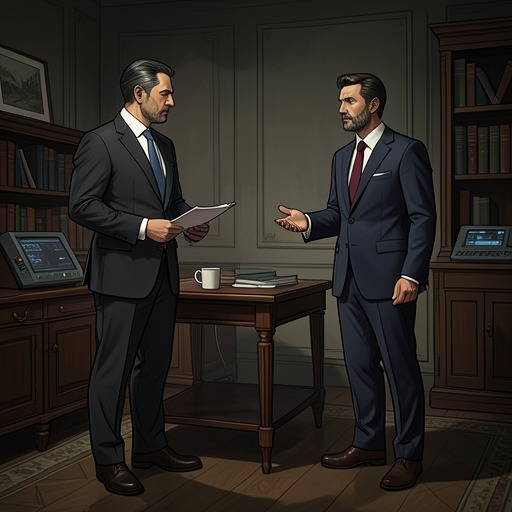
Hide and SeekJohn Rebus and Tony McCall’s friendship is tested when Tony admits that he helped mislead the investigation into Ronnie McGrath’s death. Their connection does not end with the confession: Rebus thanks Tony for earlier assistance, but also asks directly why he planted evidence. The relationship thus holds together two competing obligations—personal loyalty and the need to expose a colleague’s wrongdoing—without allowing friendship to erase responsibility.
Friendship and Professional Trust
Tony is someone Rebus can ask for help. After Tony assists him, Rebus thanks him, and Tony responds as a friend. The exchange implies an established personal trust, while the practical circumstances place that trust inside their working lives: Tony knows Pilmuir as his beat, and Rebus is pursuing a case that reaches into the same territory. Their friendship gives Rebus access to Tony’s knowledge, but it also makes the investigation’s eventual turn toward Tony personally difficult.
Earlier, when Rebus asks Tony to help, Tony breaks down and says he knows what happened at Hyde’s Club. His brother, Tommy McCall, had taken him there once; Tony found the experience disturbing and left, but worries that photographs may exist. He does not initially spell out everything. Instead, his distress brings out a compressed account of trouble at home, a desire for excitement, and fear that other people may already know. Rebus accepts the warning rather than pressing him for more. He makes clear that he will proceed with or without Tony, leaving the choice to him; Tony agrees to help. The moment reveals both the strength and the limit of their confidence: Rebus gives Tony room to decide, but does not promise to abandon the investigation.
Pressure, Complicity, and the Photograph
The pressure on Tony is made concrete when Rebus later produces a photograph he took from the files at Hyde’s. Tony looks at it fearfully, then tears it into small pieces. The source does not identify what the photograph depicts, but Tony’s earlier fear that pictures of him might exist, together with his response to this image, establishes its threatening force. The destruction is a quiet, deliberate act; it removes the photograph from view but cannot undo what Tony has done.
Rebus connects the pressure to Finlay Andrews’s interest in Tommy’s haulage company. He tells Tony that Andrews would have taken the company at a very low price. Tony’s angry reaction makes the business threat part of their conversation, while his later explanation identifies the photograph as the leverage that mattered to him. Andrews had asked for a favour, and Tony’s position on the Pilmuir beat made him useful. Tony says he placed a packet beside Ronnie’s body, treating the act as a small service to a powerful man and Ronnie as disposable because he was addicted. His justification exposes how he reduced a deliberate intervention in a death investigation to a minor favour.
Rebus’s Case and Tony’s Admission
Rebus’s earlier reconstruction helps explain why Tony’s role matters. On paper, the case appears difficult to prove: there is no indication Ronnie failed to inject himself, and an apparent supply of good heroin had been left beside the body. Rebus considers whether whoever moved Ronnie intended the clean packet to support a finding of accidental overdose. But testing also found rat poison in the heroin that killed him. The contrast between the apparently reassuring packet and the lethal supply makes the planted evidence part of a calculated misdirection, not an innocent detail. Tony’s admission confirms that he placed a packet at the scene, though Rebus’s broader reconstruction also involves Ronnie’s death and the movement of his body.
When Rebus asks why he did it, Tony first returns to the explanation that Tommy had taken him to the club and that the visit had seemed like a bit of fun. Rebus distinguishes that history from the specific question of the planted packet. Tony then acknowledges that Andrews asked him to help, and that he was willing. He had hoped that the favour would win him membership at Hyde’s and bring him into contact with influential people. He had even begun to imagine advancement in his career. His admission makes the betrayal more than a response to fear: intimidation and ambition operate together, while his friendship with Rebus does not prevent him from making a choice that obstructs Rebus’s work.
Consequences and the Limits of Loyalty
Tony predicts that he will face trial and become a figure of public disgrace, rather than attain the standing he had imagined. He leaves after telling Rebus he will see him in court. The ending makes their relationship neither a simple reconciliation nor a clean break: they have shared an honest conversation, but Tony’s confession has placed legal accountability between them. Rebus’s thanks for Tony’s help recognizes the assistance without treating it as absolution.
The contrast with the wider aftermath sharpens the personal stakes. The scandal around Hyde’s is soon reported in limited terms, and its activities remain largely unspecified in public accounts. Against that fading, incomplete record, Tony’s admission gives Rebus a concrete answer about one act of concealment. Their friendship becomes a measure of the cost of asking for that answer: Rebus can acknowledge Tony’s help and understand the pressures he faced, yet still bring the betrayal into the open. Tony, for his part, gives up the protection of silence only after confronting what he stands to lose, and accepts that their next meeting may be in court.